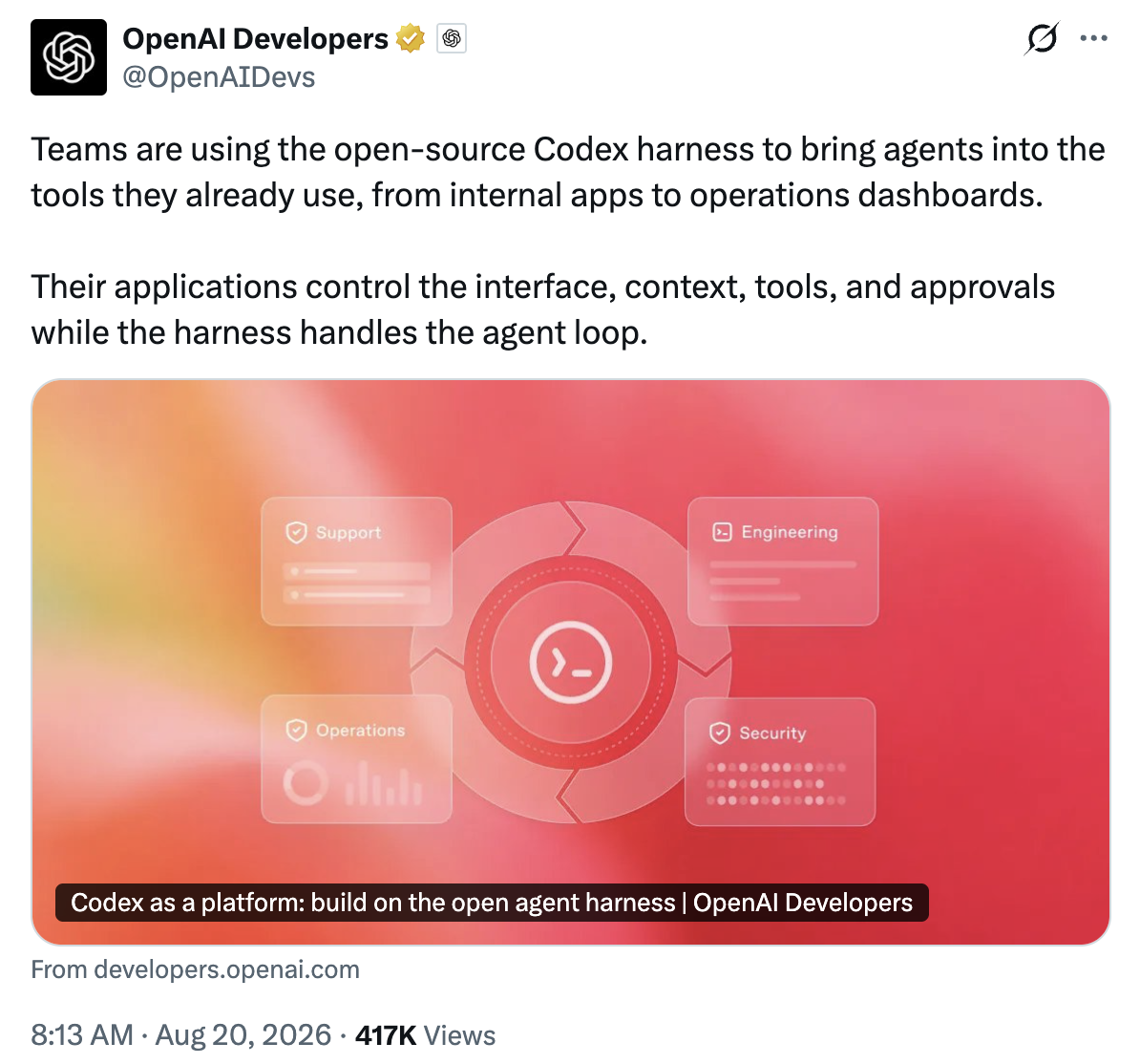
OpenAI has published a clearer account of what its open-source Codex harness is for: putting an agent inside the software where work already happens. That may be a security console, an operations dashboard, a support tool or an internal application. The product keeps its interface, business context, tools and approvals. Codex runs the agent loop underneath.
This is not the first appearance of open-source Codex code. The openai/codex repository was created in 2025 and is Apache-2.0 licensed. What OpenAI's August 19 platform post does is frame the open layer as a reusable integration surface, then spell out which pieces developers can use when a generic chat window is the wrong interface for the job.
What the Codex harness does, and what remains separate
A model response is only one part of an agent. OpenAI describes the Codex harness as the execution system around it: it maintains conversation state, gathers relevant context, calls tools, streams activity, enforces configured sandbox and approval policies, recovers from failure and carries work into later turns. That is the layer an application can inspect and adapt.
The boundary matters. OpenAI says the open-source layer is the harness and its integration surface, while model access and managed services remain separate. Apache-2.0 does not mean every Codex surface, cloud service or model is being given away. It means the published components can be inspected, modified and used under that licence.
Three ways to integrate Codex
OpenAI points to three practical entry points. codex exec is for bounded, noninteractive work such as a script, CI job or background task, and can return structured output. The official Codex SDK is for application code that needs to start, resume or stream tasks. Both fit cases where the agent is a capability rather than the entire product experience.
Codex app-server is the lower-level option for products that need the agent to feel native. Its documented client protocol lets an application connect to a local Codex process, maintain a conversation, receive streamed events, interrupt work, expose tools and respond to approval requests. That makes an approval button in an existing dashboard part of the agent workflow instead of a detour into a separate chat client.
It also means the host application has work to do. It must decide which records become context, which tools an agent can call, where it runs, what gets logged, and which actions need a person to approve. A reusable agent loop does not decide those business rules for you.
The ARC-AGI-3 result is a harness result
OpenAI gives a sharp illustration of why this layer deserves attention. It says retained reasoning and context compaction raised GPT-5.6 Sol's ARC-AGI-3 score from 13.3% to 38.3%, while cutting output tokens by six times. Those are OpenAI-reported results, but the point is narrower than the headline: the model did not change. Two choices in how the agent retained and compressed context changed the outcome.
That does not make model choice irrelevant. It does make a good warning against judging an agent only by its model label. For long tasks, the context that survives, the tools available, the stopping rules and the approval path can be as important as the next model refresh.
Relay shows the intended product pattern
OpenAI's Relay demo is a fictional shipment-operations application built on app-server. A user selects a delayed shipment and chooses Compare recovery. The application supplies the relevant shipment context; Codex can call application-owned MCP tools for current data; the resulting recommendation needs human approval before a rebooking changes a record. The dashboard then refreshes its own view.
That is a better mental model than a chatbot pasted over an existing product. The screen is not decoration. It tells the person what matters, scopes the agent's job and gives the business a place to review a proposed action. OpenAI also cites Cisco's App Builder in Cisco Cloud Control and a Thrive Holdings and Crete tax-preparation pilot that processed 7,000 returns and reduced preparation time by about a third. The latter figures are OpenAI's account of the pilot, not an independently audited study.
Open source, with no need to invent a rivalry
As checked on August 21, the openai/codex repository had about 110,000 GitHub stars. DeepSeek Harness, a separate MIT-licensed project created on August 13, had about 179,000. Both numbers move constantly and say little on their own about production fit, security or maintenance.
It is tempting to turn their proximity into a story that one project forced the other's hand. The public materials reviewed here do not establish that. The concrete news is enough: OpenAI is telling developers that the Codex loop can live inside their own tools, while those tools retain the context and authority that make an agent useful.